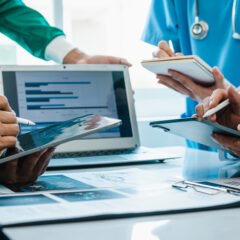

In most Indian hospitals, doctors and nurses spend a large part of every shift on paperwork: OPD prescriptions, ward notes, bedside vitals and discharge summaries. When these records sit on paper or in disconnected systems, information gets lost, work is repeated and patients wait longer. Clinical documentation software solves this by bringing outpatient, inpatient and nursing records into one connected patient record.
Why traditional documentation slows hospitals down
- Scattered records: OPD notes, inpatient files, lab reports and nursing charts live in different places, so no one sees the full patient history in one view.
- Repeated work: the same details are rewritten for prescriptions, referrals and discharge summaries.
- Missed errors: without automatic checks, drug interactions and duplicate orders depend on memory.
- Slow discharge: summaries are compiled by hand from many sources.
Key features of modern clinical documentation software
A good platform should cover the three places where most records are created: OPD, IPD and nursing. When you evaluate software, look for these features:
1. Real-time prescriptions with safety alerts
The prescription should build as the doctor types. The system should alert on drug–drug and drug–allergy interactions instantly, and calculate doses from the patient’s weight, age and renal function.
2. Voice-to-text documentation
Clinicians should be able to dictate notes, prescriptions and vitals in natural language. The software then structures the dictation into SOAP format.
3. One patient timeline across OPD and IPD
Every outpatient visit, admission, investigation and procedure should appear in a single, searchable timeline.
4. Unified order entry
Medicines, lab tests and imaging should be ordered from one screen, with duplicate order detection built in.
5. Tablet-first, offline-ready nursing tools
Nurses need touch-friendly screens for vitals and shift handover. Entries should be saved as drafts during network outages and synced automatically when the connection returns.
6. Prescriptions in regional languages
Patients follow instructions better in their own language. Look for prescriptions printed in Indian regional languages, with plain medication instructions.
7. Auto-filled discharge summaries
Discharge summaries should be pre-filled from admission data, notes, investigations and medications. The doctor only needs to review and sign.
How totEM by CAREWORKS® brings it together
totEM by CAREWORKS® is Sofscript’s clinical documentation platform, built for Indian hospital workflows and backed by 30 years of healthcare software experience. It combines three modules in one system:
- Outpatient EMR: real-time prescriptions, ICD-10 coding, queue management and e-prescriptions.
- Inpatient EMR: CPOE, bed management, MAR verification and auto-filled discharge summaries.
- Nursing Flow Sheet: vital signs, intake/output charting, SBAR handover and NEWS/MEWS scoring.
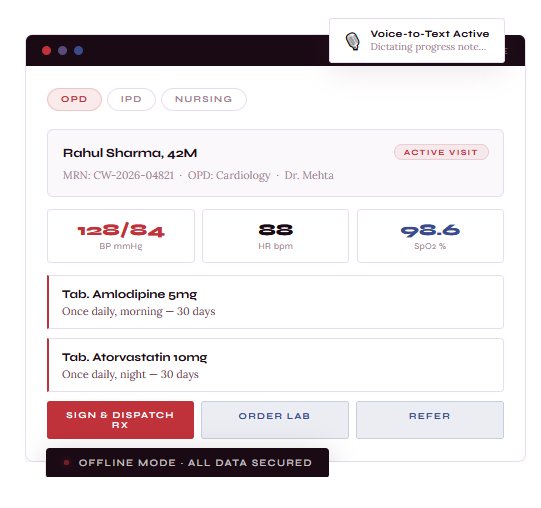
totEM also includes voice-captured vitals, specialty templates that clinicians can customise, and token-based queue management for the OPD. It works alongside CAREWORKS® HMIS for hospital operations and CAREWORKS® LIS for laboratory workflows, so clinical, operational and lab data stay connected.
To see how digital documentation fits into wider hospital workflows, read our article on transforming clinical documentation with Slate by CareWorks.
Frequently asked questions
What is clinical documentation software?
It is software that lets doctors and nurses record prescriptions, notes, orders, vitals and discharge summaries digitally, in one connected patient record.
How is an EMR different from an HMIS?
An EMR stores clinical information about the patient. An HMIS manages hospital operations such as registration, billing and inventory. They work best together, like totEM and CAREWORKS® HMIS.
Can nurses use totEM at the bedside?
Yes. The Nursing Flow Sheet is tablet-first, supports voice-captured vitals, and saves drafts offline.
See totEM in action
Planning to move from paper or disconnected systems to connected clinical documentation? Schedule a free demo with the Sofscript team and see totEM by CAREWORKS® working for your OPD, wards and nursing staff.